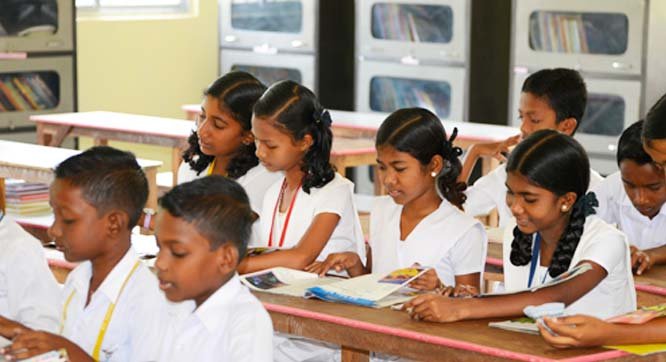
The school offers education from Nursery to Class XII, providing a strong academic foundation from early childhood education to the senior secondary level in accordance with the norms of the Central Board of Secondary Education (CBSE), New Delhi.
Pre-Primary Classes
Nursery (age 3-4)
LKG (Lower Kindergarten, age 4-5)
UKG (Upper Kindergarten, age 5-6)
Primary Classes
Class I (age 6-7)
Class II (age 7-8)
Class III (age 8-9)
Class IV (age 9-10)
Class V (age 10-11)
Upper Primary/Middle Classes
Class VI (age 11-12)
Class VII (age 12-13)
Class VIII (age 13-14)
Secondary Classes
Class IX (age 14-15)
Class X (age 15-16)
Higher Secondary Classes
Class XI (age 16-17)
Class XII (age 17-18)
Primary (Classes 1–5) – focus on basics of reading, writing, arithmetic, languages, and environmental studies.
Secondary (Classes 6–10) – broader subject‑based learning in core areas like Mathematics, Science, Social Science, and Languages, with greater emphasis on understanding over rote memorization.
Senior Secondary (Classes 11–12) – stream‑based learning (Science, Commerce, Humanities) with optional and skill‑based subjects chosen according to the student’s career path.

The CBSE examination pattern is a structured way of assessing students in Classes 10 and 12 through board exams, internal assessments, and specific question‑type weightage. It has been recently updated to focus more on understanding, application, and competency‑based questions rather than pure memory‑based recall.
Main structure (Class 10 & 12)
Each subject’s theory paper is usually 80 marks, with 20 marks for internal assessment (periodic tests, projects, practicals, assignments).
The board exam duration is generally 3 hours for major theory subjects in both Classes 10 and 12.
For Class 10, students can appear for two board‑exam windows (Phase 1 and Phase 2); the best score is taken as the final result.
Question‑type pattern (Theory Paper)
Competency‑based questions (MCQs, case‑based, source‑based, paragraph‑based, etc.) carry about 50% weightage in the paper.
Objective‑type / MCQs are around 20%, testing direct factual recall or short application.
Short‑answer and long‑answer questions (descriptive/analytical) make up the remaining 30–40%, testing understanding, reasoning, and writing skills.
Internal assessment and practicals
Internal assessment includes periodic tests, projects, activities, and practicals, counted over the academic year.
For practical‑based subjects (like Science or Maths), the practical/board‑lab exam along with internal work contributes to the overall 100‑mark score.
If you tell me whether you want this for Class 10, Class 12, or a generic school‑website line, I can draft a short exam‑pattern paragraph tailored to your site.
Central Board of
Secondary Education
National Council of Educational Research & Training